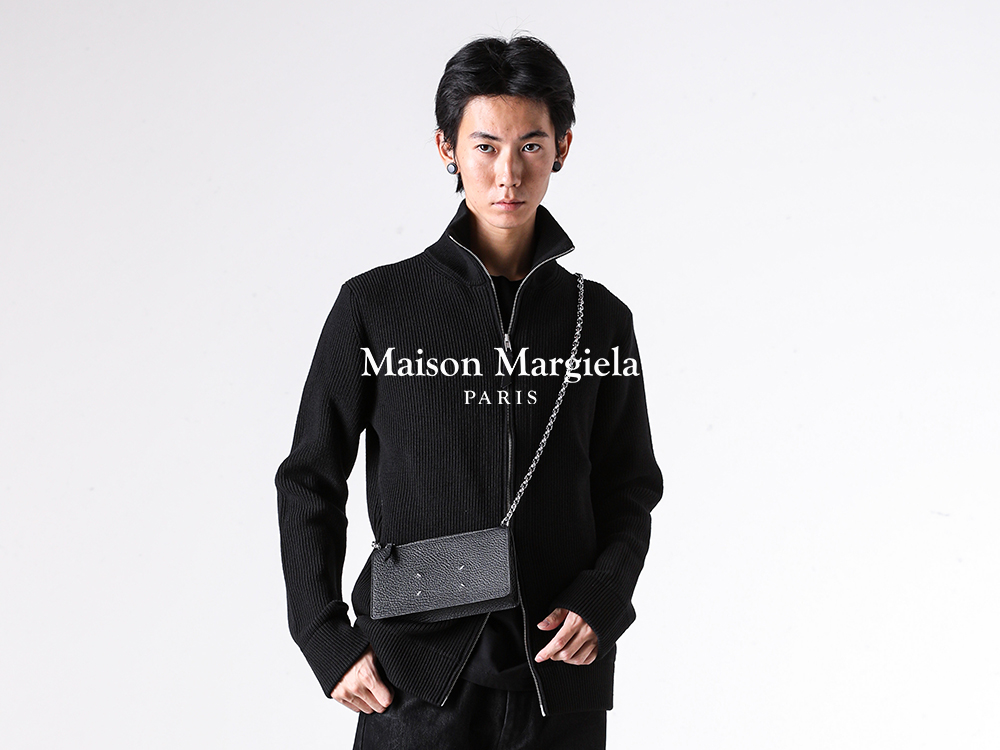
The “Drivers Knit,” one of the signature items of Maison Margiela, was born with the launch of the menswear line in 1999 and has been produced for more than a quarter of a century as a kind of “permanent staple” in the wardrobe.
In Japan it is commonly known by the nickname “Drivers Knit,” but overseas it is often called “Trucker Knit” or “Camionneur” (French for truck driver).
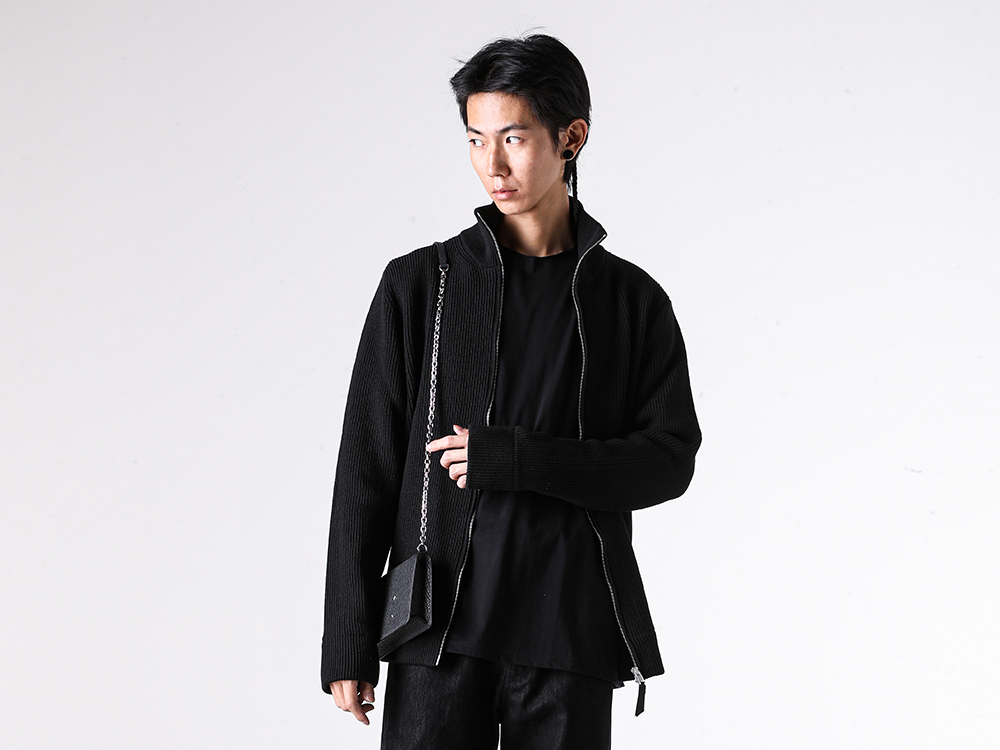
As the name suggests, its roots lie in cold-weather knits actually worn by long-distance truck drivers. Based on functional details such as a stand collar, double zip (a zipper that can be opened from both top and bottom), and a pocketless design, it is reconstructed through Margiela’s minimalist aesthetic.
In this article, we will break down the Maison Margiela Drivers Knit step by step, explaining everything from design and details to materials, construction, and maintenance.
This is written for those who want to choose a “for-life” knit, are unsure about their first Margiela piece, or wish to fully understand the quality of the materials and construction before purchasing.
Design & Wearing Experience: Functional Beauty and Comfort Rooted in Workwear
Design and Details Pursuing Functional Beauty
The prototype of the Drivers Knit was a gilet-style (sleeveless) knit vest presented in the Spring/Summer 1999 menswear line “Line 10.”
In the Fall/Winter season of the same year, a long-sleeve version was introduced, completing a structure almost identical to today’s Drivers Knit.
Its original source lies in highly practical knitwear worn by long-distance truck drivers, and each detail born from that demanding working environment carries a clear and purposeful reason.
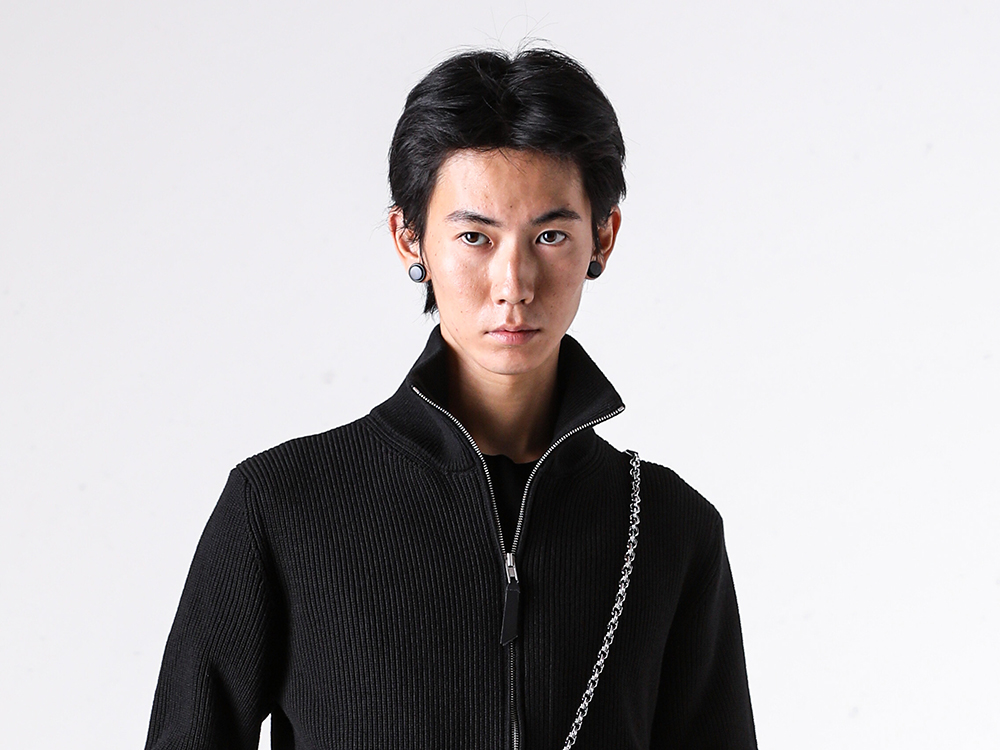
Stand collar refers to a collar design that stands up around the neck.
Unlike a turtleneck, it is formed as a single tubular piece without folding over, which helps preserve a wide range of neck motion.
It was adopted as a practical shape that protects the neck from cold air when driving with windows open, while not interfering with movements such as checking behind.
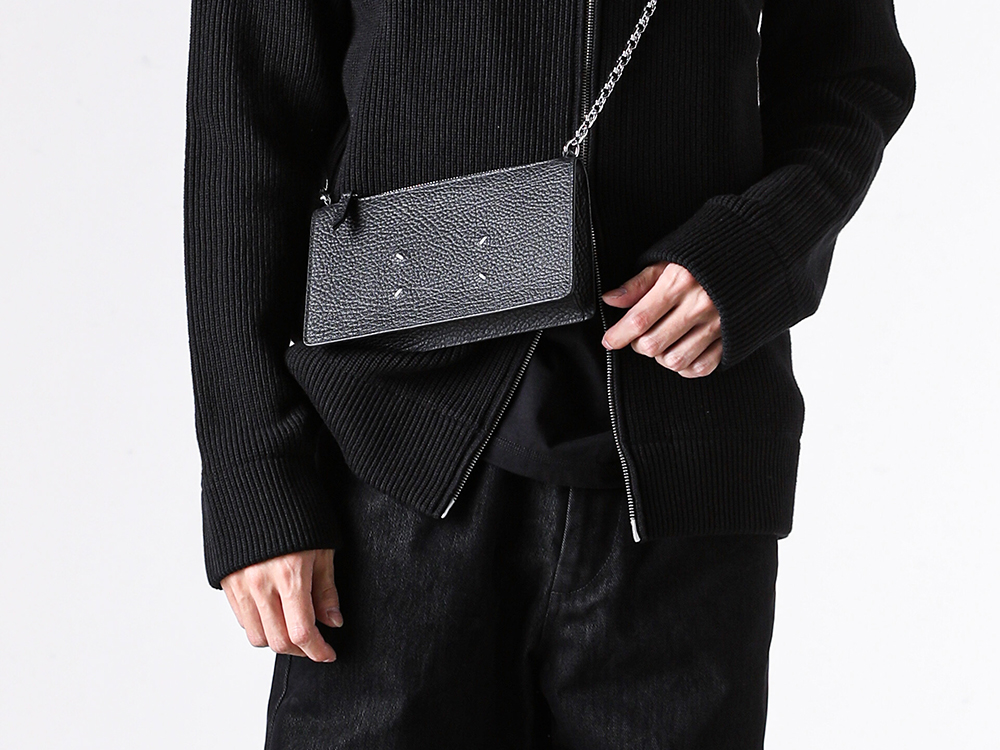
Double zip (reverse-opening zipper) is a zipper equipped with sliders on both ends, allowing it to be opened from the top or the bottom.
By opening it slightly from the bottom when seated, it relieves tightness around the hem and waist, maintaining comfort even during long hours of driving.
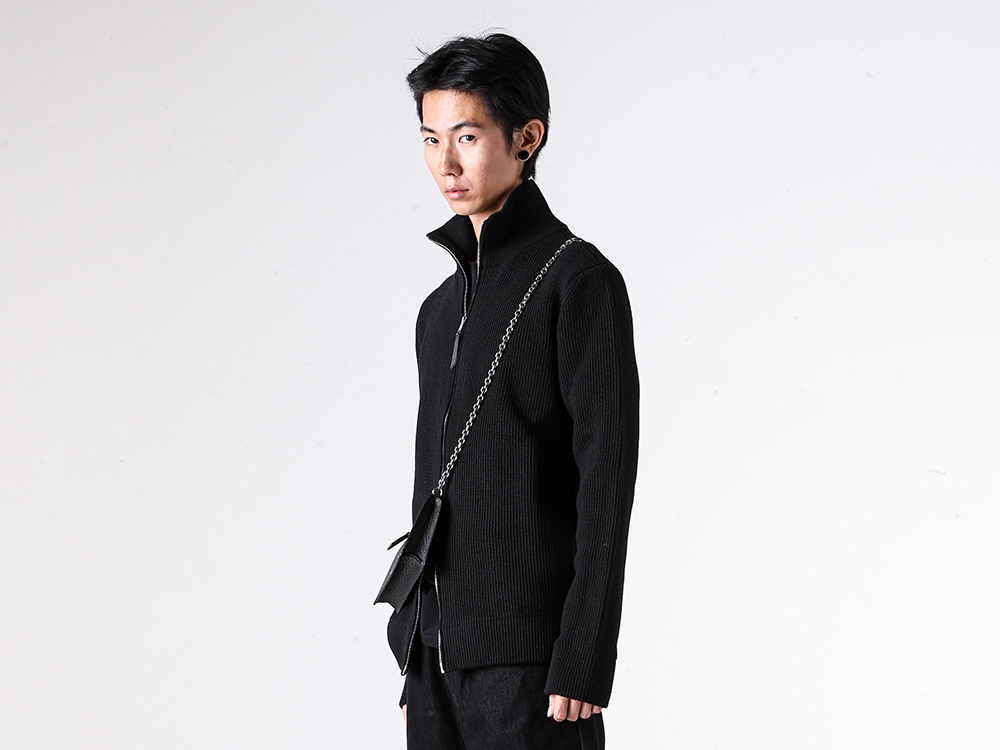
Pocketless design (intentionally omitting pockets) is a consideration to prevent garments from catching on gears or steering wheels in cramped driver seats.
By thoroughly removing pockets and unnecessary decoration from the front, only the shadows of the vertically running rib knit are emphasized, creating an extremely minimal expression.
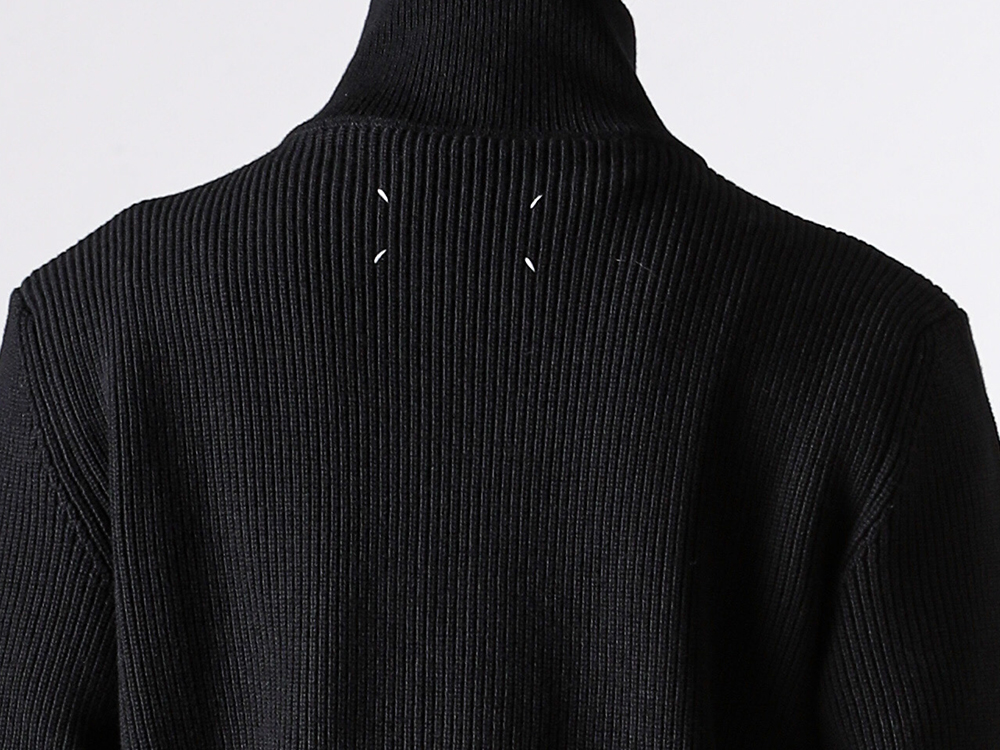
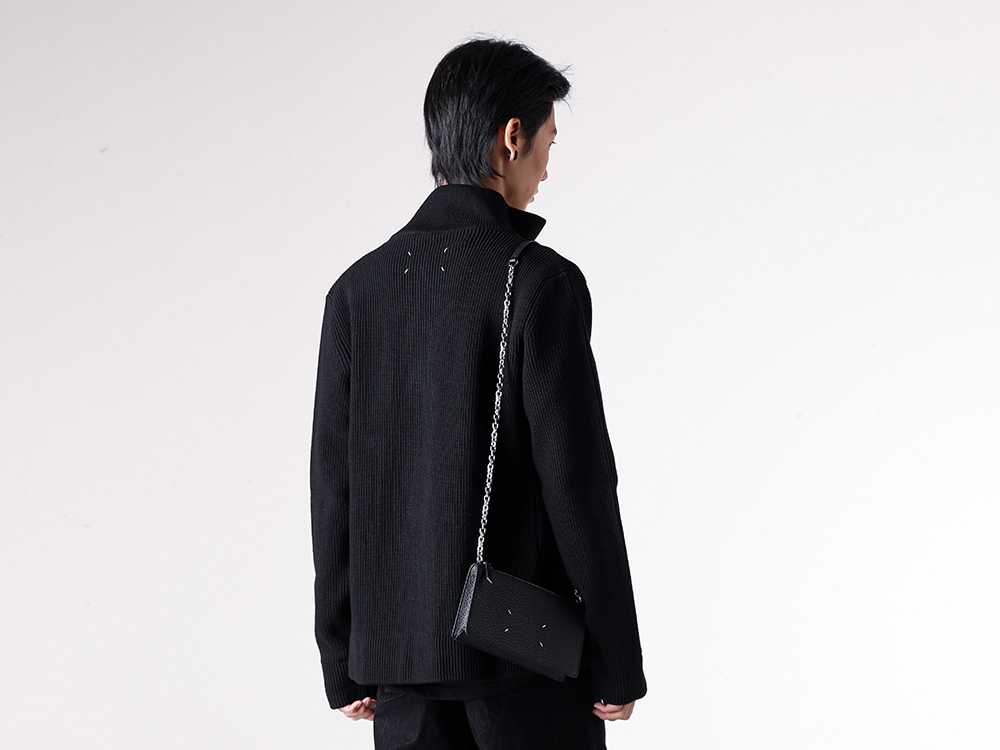
Maison Margiela elevates these practical, workwear-derived details by respecting them as design in their own right, while pairing them with the brand’s concept of “anonymity”—signaled not by visible logos but by the four stitches on the back—thus creating a knit that balances functional beauty with quiet presence.
Silhouette and Fit That Naturally Conform to the Body
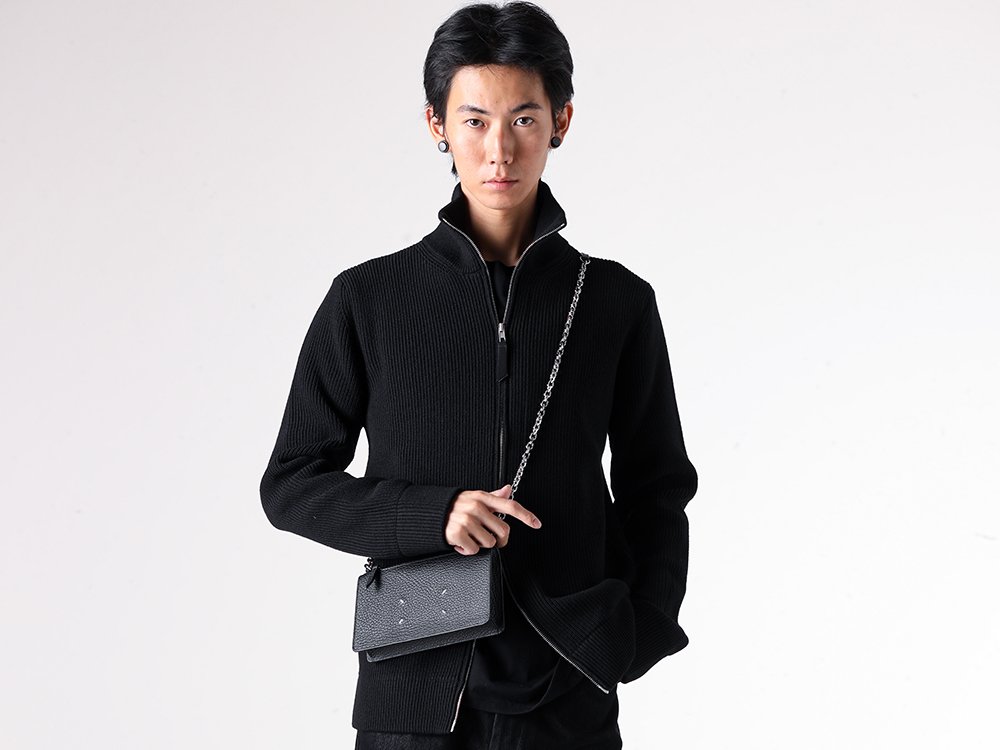
What defines the impression of the Drivers Knit is its 7-gauge rib knitting. “Gauge” refers to the density of needles on a knitting machine; the smaller the number, the thicker the yarn and the denser the knit. A 7-gauge knit sits between chunky low-gauge and fine high-gauge knits, offering substantial thickness and density.
Rib knitting alternates knit and purl stitches vertically to form raised ridges. These vertical lines enhance stretch, delivering a body-hugging fit along with excellent kickback (recovery) that returns the fabric to its original shape.
Because the entire body of the Drivers Knit is constructed with this rib knit, it appears quite narrow when laid flat. However, when worn, it expands horizontally and fits the body as if clinging to it. The vertical ribs create a visual “I-line” (a straight, vertical silhouette), helping prevent the bulky appearance often associated with thick knits and keeping the silhouette stable even when layered under a coat.
Wearing Feel: A Solid Touch Unique to Cotton × Wool Rib
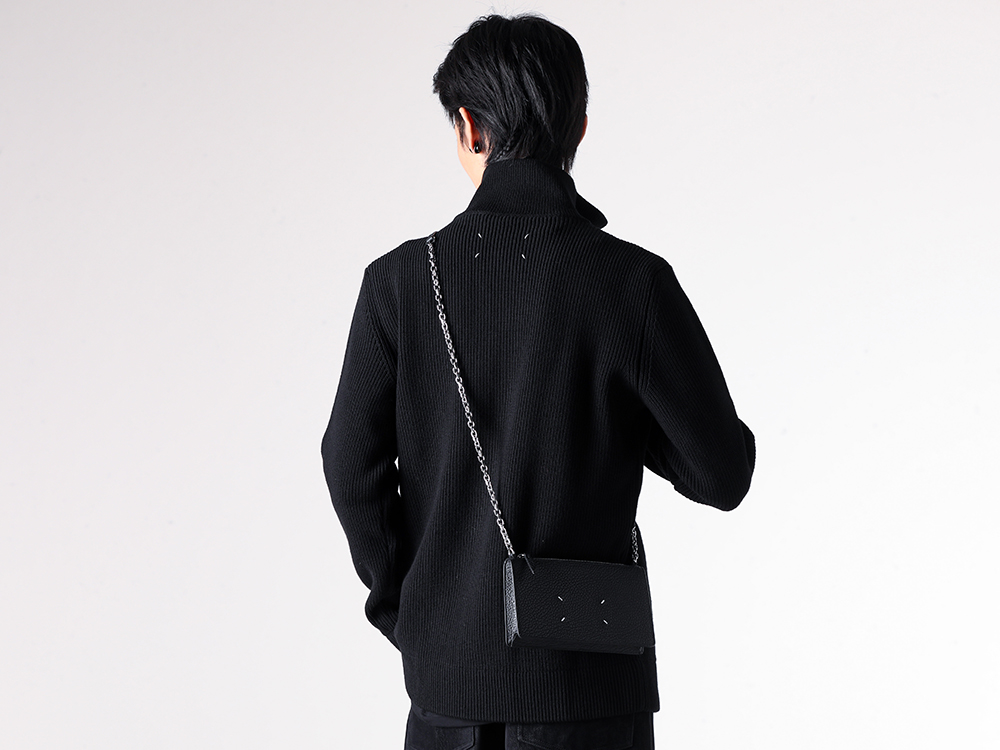
Early 100% wool models feel almost armor-like in weight when handled, yet thanks to the high elasticity of rib knitting and the three-dimensional patterning, they are surprisingly easy to move in once worn, reducing tightness around the shoulders and elbows during driving or desk work.
In recent years, the mainstream 60% cotton / 40% wool blend models achieve a well-balanced coexistence of wool’s warmth and cotton’s breathability and softness, making them suitable not only as winter insulation but also for heated interiors and as outer layers in spring and autumn.
By slightly opening the double zip from the bottom, pressure around the waist when seated is alleviated, reducing stress during long periods of travel or work and reinforcing the impression of a knit that can be worn comfortably all day.
The Source of the Drivers Knit’s Value: Cotton × Wool Rib Construction and Uncompromising Craftsmanship
Carefully Selected Materials: Characteristics, Function, and Background of Cotton × Wool Rib
Looking back at the history of the Drivers Knit, its material composition can broadly be divided into two distinct periods.
From the early years through the mid-2010s, most models were made from 100% wool. By knitting dense ribs from substantial wool yarns, these pieces achieved exceptional warmth—enough to function as winter outerwear—along with durability that resisted sagging even after years of wear.
At the same time, this resulted in a noticeable weight, and some pieces exhibited the characteristic itchiness of wool, giving them an almost “connoisseur-level” character.
In contrast, recent standard models have adopted a cotton 60% / wool 40% blend as the norm.
By using cotton as the base, breathability and softness against the skin are significantly improved, creating a well-balanced piece suitable as a layering garment across three seasons—autumn, winter, and spring.
With 40% wool content, sufficient warmth is still ensured, while preventing overheating indoors and making it easy to wear casually, even directly over a T-shirt.
Additionally, in certain seasons, variations using more luxurious yarns blended with cashmere, or drier-touch yarns blended with linen, have also been released.
Regardless of the material, all selections are based on meeting three essential requirements: sufficient firmness and body to sustain the silhouette, elasticity that allows the rib structure to stand beautifully, and the ability to develop richer character through aging. Rather than simply using expensive materials, each is carefully chosen as a practical fabric that supports both design and comfort.
The Crystallization of Craftsmanship: The Secrets of Knitting, Construction, and Pattern Making
From the late 1990s to the early 2000s, Drivers Knits were produced at a factory led by Italian knit artisans Miss Deanna.
This workshop, which has handled knitwear for many maisons such as Saint Laurent and Comme des Garçons, is distinguished above all by its exceptional knitting density.
By applying strong tension to the yarn and knitting it into 7-gauge ribs, the resulting knits resist sagging during wear and possess remarkable shape retention, standing up to their own weight and friction.
Production later transitioned to Staff International under the OTB Group. While the knit texture became slightly milder, consistency across sizes and uniformity in sewing improved, refining the level of “industrial product completion” demanded of a global brand.
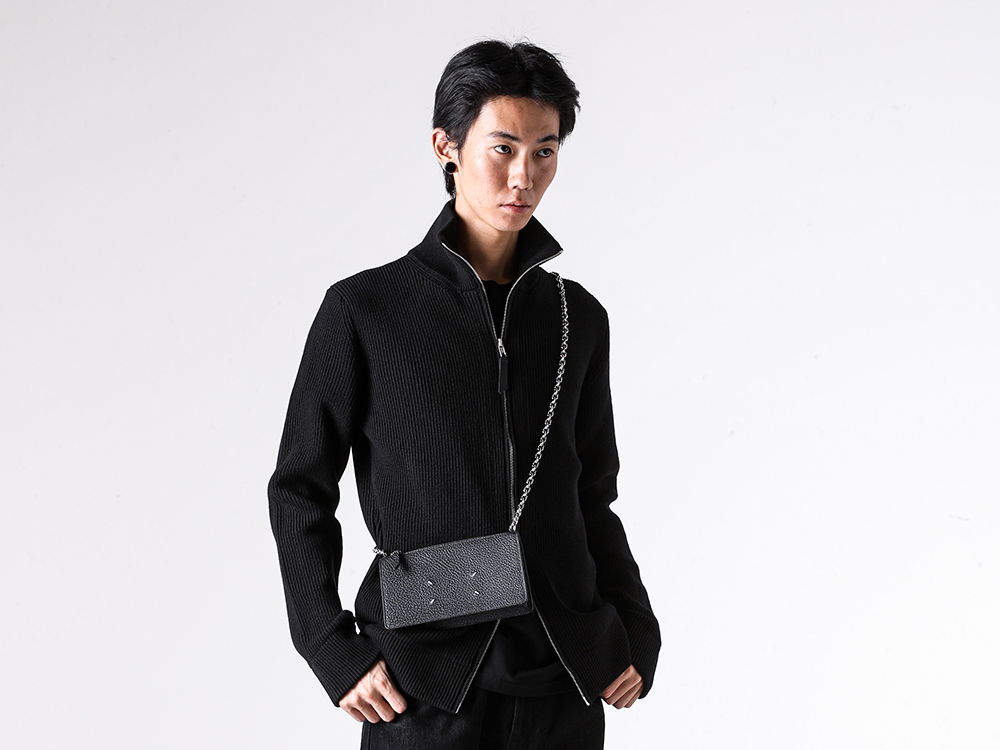
The patterns are designed closer to those of tailored jackets, with calculated shoulder slopes, sleeve attachment angles, and curves that follow the natural roundness of the back, allowing even a thick rib knit to maintain a clean vertical line when viewed from the side.
Visible stitching on the exterior is kept to a minimum, while internally, seam allowances and rib transition points are carefully finished. This construction makes the knit more resistant to long-term wear and cleaning, reducing the likelihood of stretching or losing its shape.
The four stitches on the back were originally practical stitches used to temporarily attach the calendar tag, but today they are positioned as an iconic maison detail that simultaneously embodies “anonymity” and “symbolism.”
Commitment to Quality and Durability: Why It Can Be Loved for Years
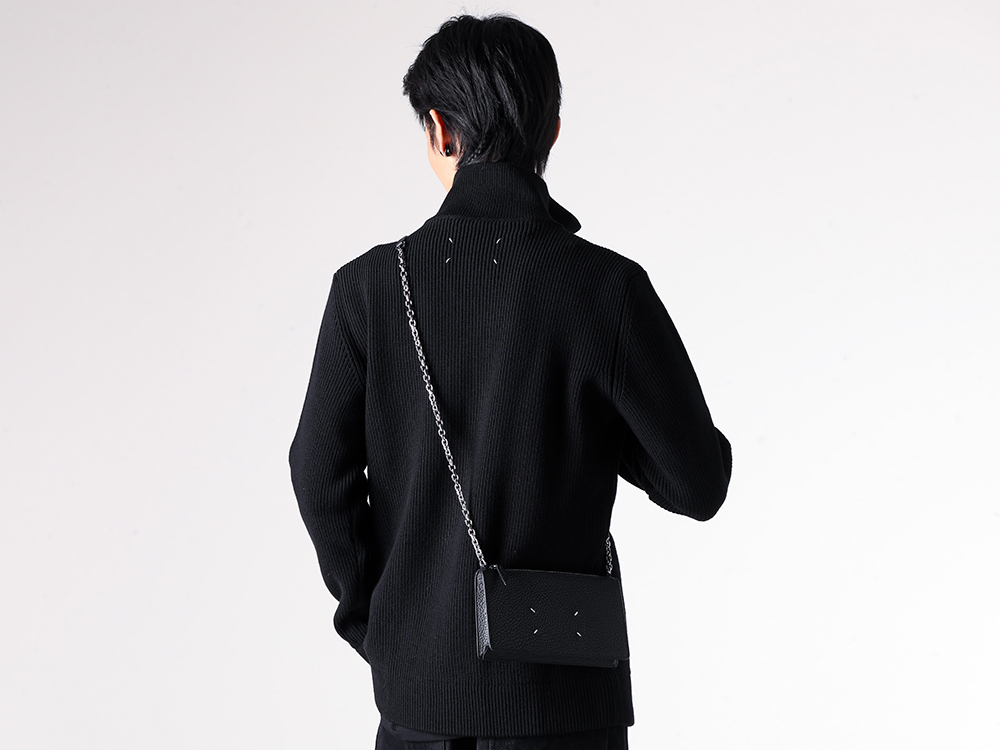
High-density rib knitting, carefully calculated patterns, and appropriate yarn thickness and blending ratios.
When these three elements come together, the Drivers Knit gains a major strength: a silhouette that resists collapse even after long-term wear.
With proper care, it is entirely realistic for this knit to remain in a wardrobe for a decade or more. In fact, as time passes, the rib texture softens slightly and gradually adapts to the wearer’s body, allowing the aging process itself to be enjoyed.
Its timeless design, free from reliance on passing trends, further enhances its value as a lasting garment.
Unaffected by seasonal trends and unlikely to feel dated even when taken out of the closet years later, this piece functions as a core wardrobe item for far longer than its price might suggest.
Basic Specifications of the Drivers Knit
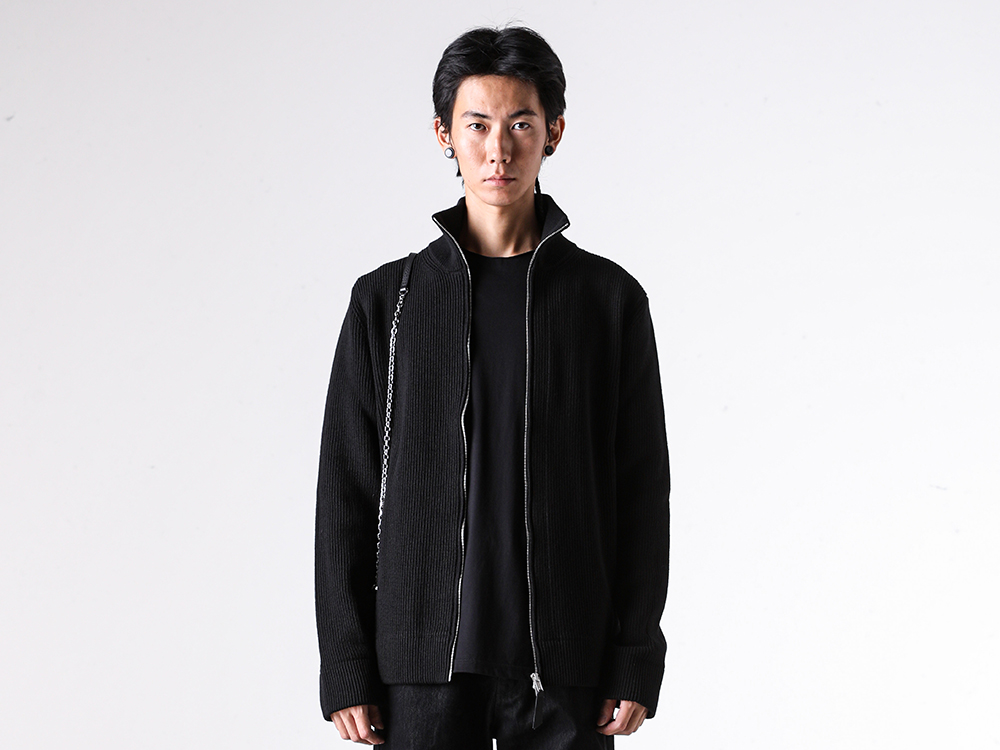
- Product Name: Driver's Zip Up Knit
- Item Code: SI1HA0013
- Color: Black
- Available Sizes: [S] / [M]
- Material: 60% Cotton / 40% Wool
- Country of Origin: Italy
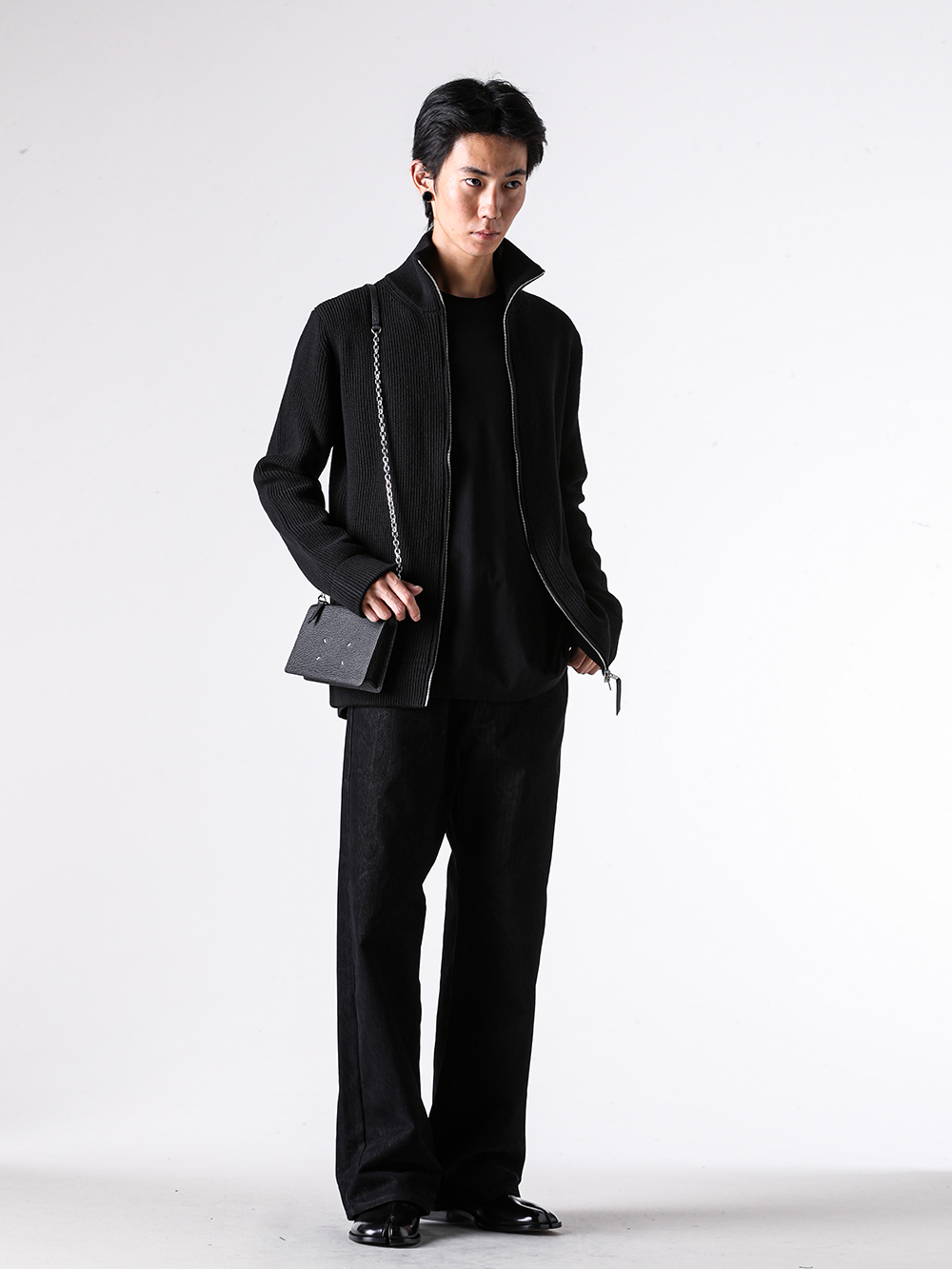
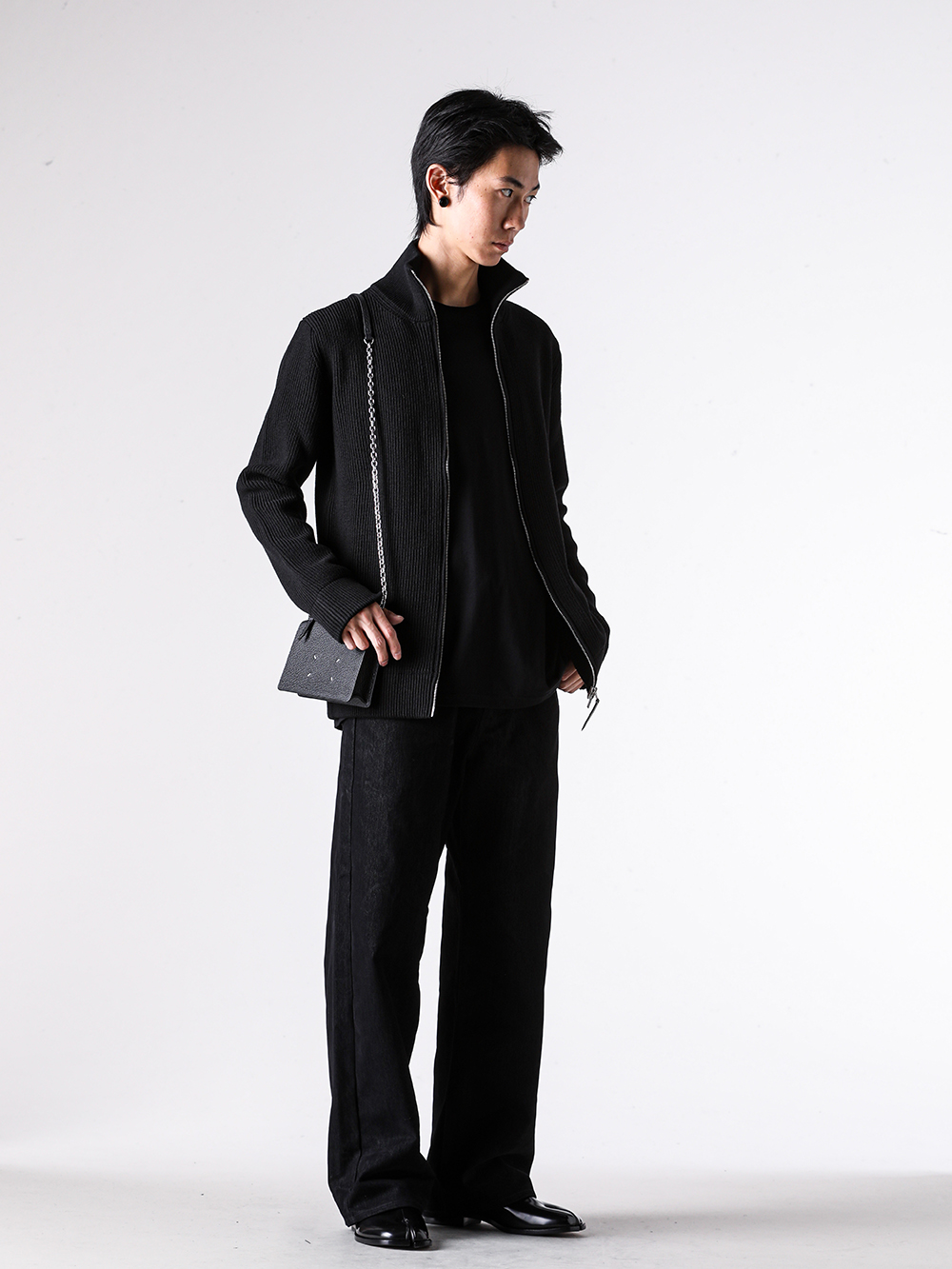
Coordinate Styling: The Practicality and Versatility of the Drivers Knit
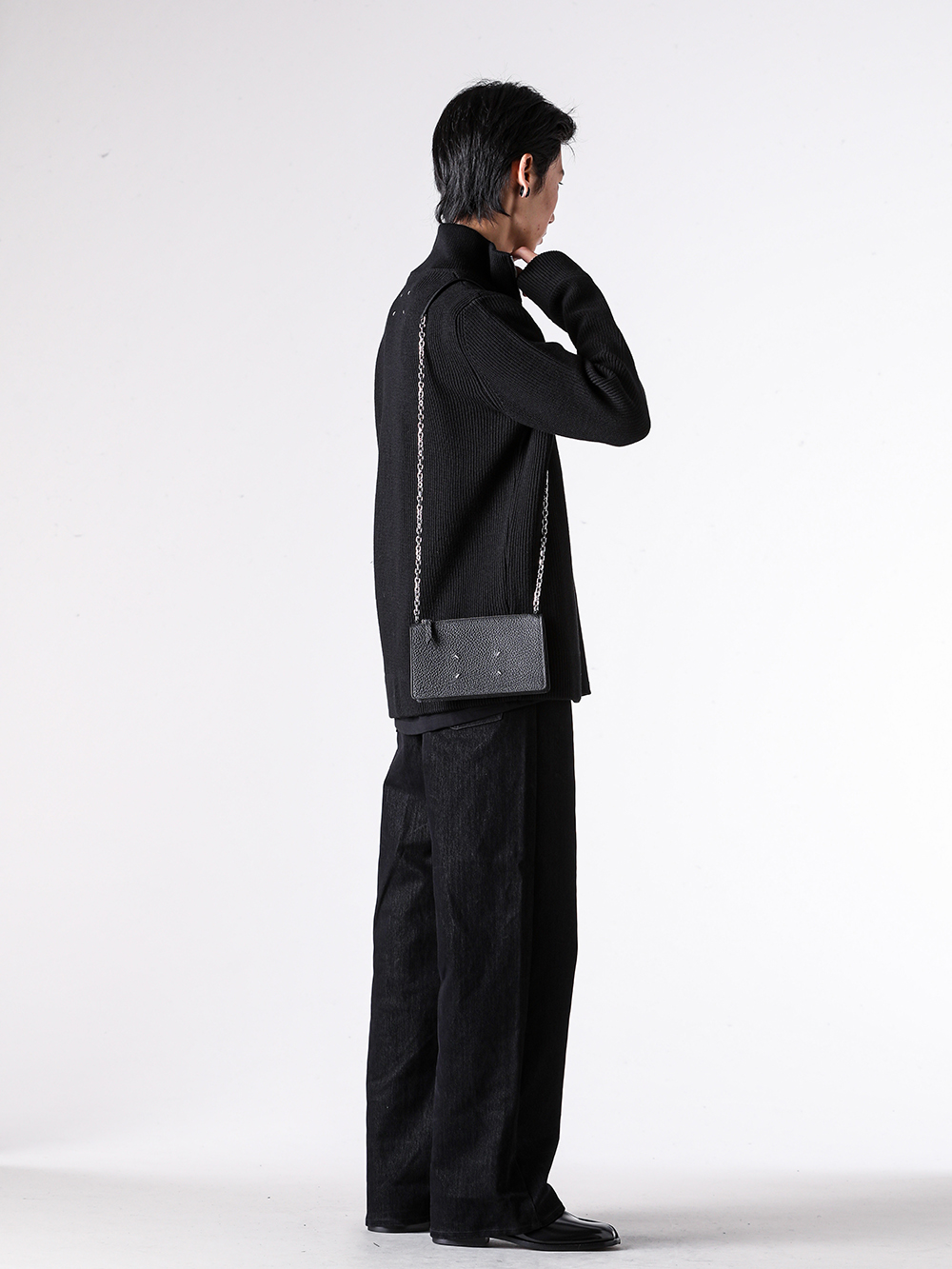
Size Selection: Choosing a Piece You Can Wear Comfortably for Years
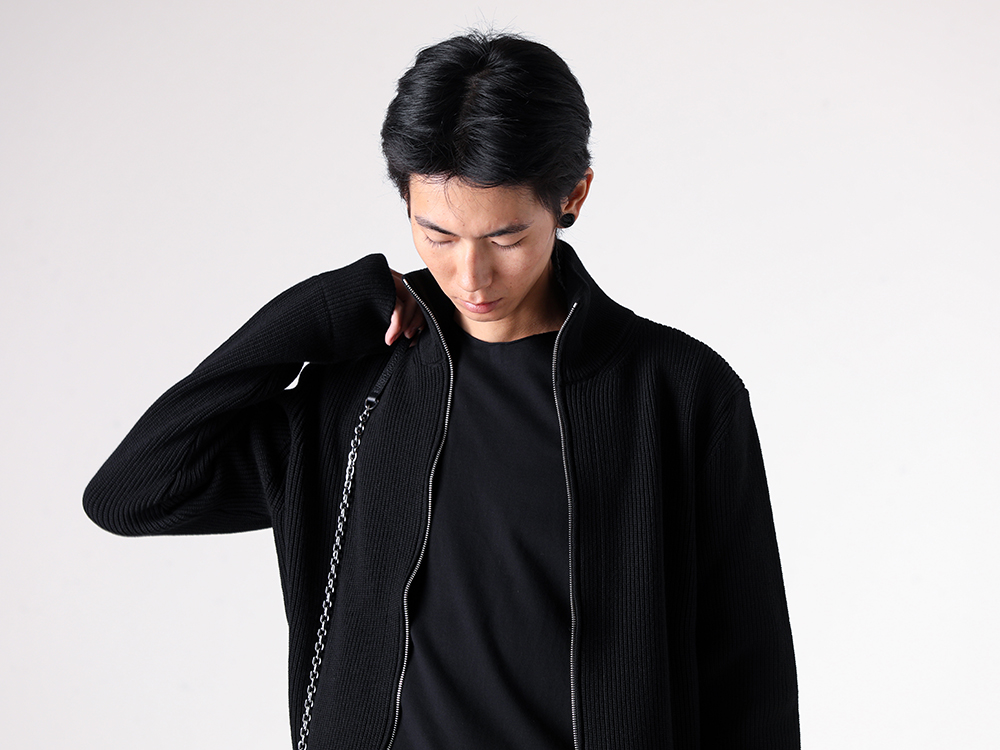
Understanding the Unique Fit and How to Choose the Right Size
The Drivers Knit is worn not by its flat measurements, but by the stretch of the rib knit.
For this reason, if you judge the size only by the numbers—using the same 기준 as standard cut-and-sew tops or sweatshirts—it may appear slightly small on paper.
In reality, the rib knit expands firmly in the horizontal direction, providing more fit and mobility than the measurements suggest.
If you want a true-to-size fit, choosing the same size as your usual jacket, or even one size down, tends to create a silhouette that follows the body nicely.
If you prefer a more relaxed, mode-oriented look, sizing up by one allows you to layer thicker knits underneath or use it as a light outer layer with balanced proportions.
Maintenance and Care for Long-Term Use: Preserving Quality
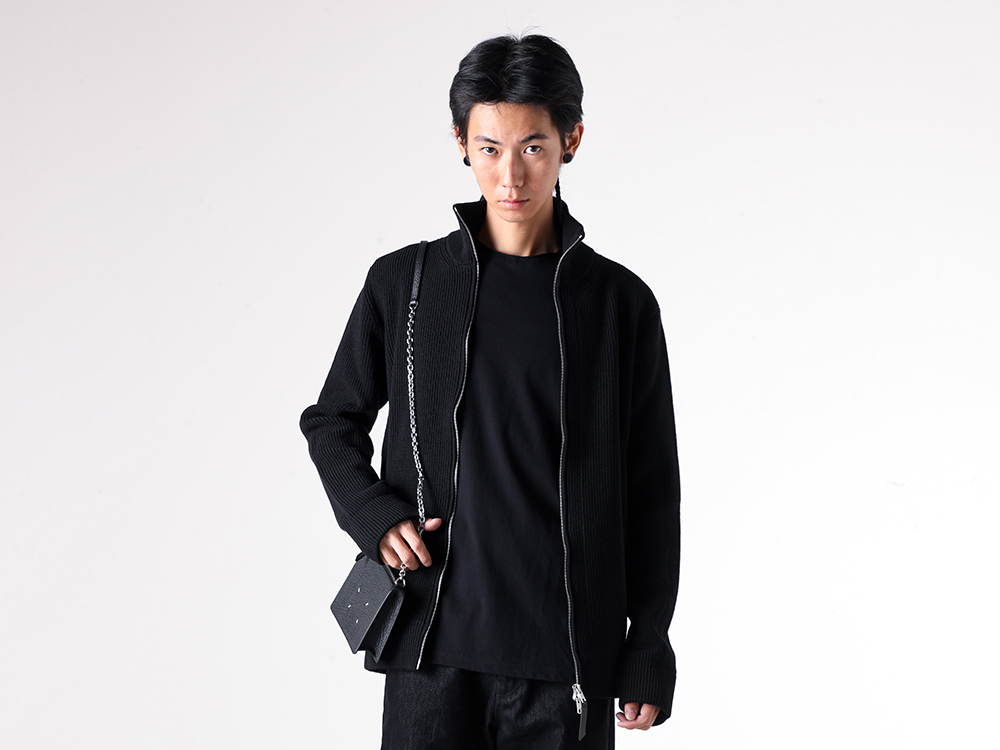
Proper Care Methods Matched to the Material’s Characteristics
The care label for the Drivers Knit consistently recommends dry cleaning.
This is to avoid the risks of felting and loss of shape that are characteristic of wool and wool-blend knits.
Wool fibers have a scaly surface structure known as “scales,” and when water, friction, and temperature changes are applied, these scales interlock, causing dramatic shrinkage and hardening.
When felting occurs in a high-density 7-gauge rib knit, even a single wash can result in shrinkage of several centimeters in both length and width, and it is nearly impossible to restore the garment to its original state.
In addition, when a heavy knit is soaked in water, it stretches downward under its own weight. If it is then hung on a hanger to dry, hanger marks like sharp edges can appear at the shoulders, and the overall length may stretch.
Furthermore, while the fabric itself shrinks, the zipper tape does not, which can cause wavy puckering along the front placket and disturb the clean, linear lines characteristic of the Drivers Knit.
To avoid these risks, it is safest to rely on dry cleaning at a professional cleaner experienced with high-end garments.
Ironing Tips and Wrinkle Care
High-density rib knit is naturally resistant to deep wrinkles, so ironing is rarely necessary during everyday wear.
If fold lines become noticeable, it is recommended to lightly apply steam from a short distance using a steam iron, then gently reshape the garment by hand.
If you need to apply the iron directly, always use a pressing cloth and keep the temperature setting at “medium” or below.
Pressing too firmly and flattening the rib texture can cause the loss of its characteristic three-dimensionality, so think in terms of “resting” the iron or “reviving with steam” rather than pressing down.
Please avoid applying the iron directly to the zipper or leather pull tab.
Precautions for Use
The one thing to avoid most when storing a Drivers Knit is long-term storage on a hanger.
Because a 7-gauge rib knit carries substantial weight, hanging it can cause gravity to pull the garment downward, leading to shoulder drop, protrusions around the neckline or shoulders, and stretching in body length.
Always store it folded, and using a breathable nonwoven fabric cover along with a moth repellent will greatly reduce the risk of insect damage, mold, and loss of shape.
Wool and cotton knitwear will inevitably develop pilling due to friction. Particular attention should be paid to areas such as the chest where a seat belt rubs, under the arms, and around the cuffs.
Tearing pills off by hand can damage the fibers and create further fuzzing. Ideally, use an electric fabric shaver or a knit brush to gently groom only the surface.
The leather pull tabs used on recent models may harden with repeated dry cleaning, so avoid unnecessary cleaning. Applying a very thin layer of leather cream when needed helps maintain better condition over time.
Benefits of Purchasing From Our Store and Our Reliable Support System
Pre- and Post-Purchase Support by In-Store Staff
Our staff, who handle many imported brands including Maison Margiela on a daily basis, are happy to carefully address any concerns or questions before purchase—such as sizing, material feel, perceived weight, or compatibility with your existing wardrobe.
Even after your purchase, please feel free to consult us at any time, either online or in-store, regarding care, storage, or alterations, so you can enjoy the piece for years to come.
In-Store Experience and Advice at Our Kyoto Location
At our physical stores, including the Kyoto location, you can actually pick up the Drivers Knit and check its weight and texture in person.
You can also try on different sizes to find the perfect fit, or test styling combinations on the spot with outerwear and pants from other brands.
Whether online or in-store, we are happy to help you choose the single best piece for you.
Is the Drivers Knit a “Genuine” Piece for Those Who Value Quality?
The Unshakable Value of the Drivers Knit
Since its debut in 1999, the Drivers Knit has remained largely unchanged in its core structure: the high stand collar, double zip, full rib knit, pocketless design, and the four stitches on the back.
At the same time, internal elements such as material composition, zipper specifications, label details, and genderless proposals have been flexibly updated to suit the times.
This reflects an approach of “continuing to change only what is necessary in order to remain unchanged.”
Because the outward design remains timeless while the inner elements are continuously adjusted to fit modern lifestyles, it continues to be supported by many people as a truly “current” knit.
For Those Who Are Still Hesitating
Judging by price alone, the Drivers Knit is by no means an easy purchase.
However, when you factor in its durability for 10 years or more, its timeless quality that eliminates the need for seasonal replacements, and its strong resale value when you eventually part with it, it becomes less a “high-priced knit” and more a “long-term tool.”
If you are currently thinking, “It’s time to own one truly good knit,” or “I want to welcome one of Maison Margiela’s signature pieces into my wardrobe,” the Drivers Knit is certainly an item worth serious consideration.