A Thorough Guide to the Warmth Indicator “Fill Power” for Down Jackets
Definitive Guide
A Thorough Guide to the Warmth Indicator “Fill Power” for Down Jackets!
Understand how fill power works, how to choose the right one, and the characteristics of different brands—so you can select the perfect piece for your needs.
What Is Fill Power? A Guide to Down Jacket Warmth
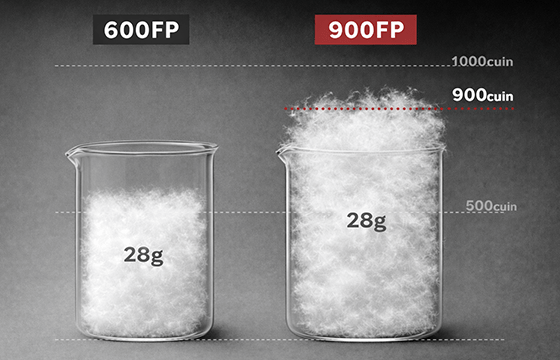
Fill power is a numerical value that represents the loft (degree of fluffiness) of down in cubic inches. The higher the number, the more air the down can trap, allowing for greater warmth even with a smaller amount of fill. Understanding this indicator is the first step in choosing the right down jacket.
Fill power (FP) is a representative indicator of down performance and serves as a standard for comparing quality.
The loft (in cubic inches) of 1 ounce (approximately 28 g) of down is measured under a set load to evaluate lightness and warmth.
Understanding Fill Power (FP) Values
FP is a value expressed in cuin that indicates the loft of down. Higher values mean the down traps more air, providing greater insulation even with lighter weight. A higher FP allows for high-performance down products using less fill.
Fill power, also written as Fill Power or FP, refers to the loft measured in cubic inches (cuin) when a fixed load is applied to 1 ounce (approximately 28 g) of down. Even with the same amount of down, materials that loft more easily achieve higher values and superior insulation. The higher the number, the more air layers can be retained, resulting in greater warmth with less down.
Warmth Guidelines and Use Cases by Fill Power Value
FP is an important benchmark for determining usage scenarios. 400–500 FP is suitable for spring/autumn or inner layers, 600–700 FP for everyday winter city wear, and 800 FP or higher for mountaineering or extreme cold regions. Higher is not always better—choosing according to your lifestyle is key.
General guidelines by fill power value are as follows. Visualize the intended use and temperature to choose the range that best fits your needs.
← Horizontal scrolling available →
Fill Power
Temperature
Scene
Use
400–500 FP
Relatively warm days above 10°C
Early spring or fall, slightly chilly days, indoors
Inner down, lightweight outerwear
600–700 FP
Chilly days around 5°C–10°C
Everyday winter use (city, commuting, school)
Main outerwear, well-balanced daily use
800 FP or higher
Extreme cold below freezing (0°C or lower)
Mountaineering, skiing, activities in severe cold regions
High-quality, highly specialized outerwear
While higher FP generally means greater insulation, it can feel too warm depending on transportation and environment. Choose the appropriate range to suit your lifestyle.
Fill Power Measurement Process and Key Points to Note
Measurements are conducted under controlled conditions. If factors such as the dryness of the down or the duration of applied load differ, values can vary even for the same material, making standardized testing environments essential.
In testing, 1 ounce (approximately 28 g) of down is placed into a cylinder and a fixed load is applied to measure its loft. If the down is damp, its volume decreases; if overly dry, dust may increase—environmental differences can affect results. For this reason, brands calculate values under standardized conditions based on common regulations such as JIS or IDFB.
Although the numerical value is useful as a quality indicator, perceived warmth can vary greatly depending on fill amount and construction.
Rather than relying solely on catalog numbers, try the actual volume and fit to determine the most suitable piece.
Key Factors Affecting Warmth Beyond Fill Power
FP is only one indicator. Even with the same FP, warmth can vary depending on fill amount, down-to-feather ratio, fabric, waterproof/water-repellent performance, and construction.
Warmth cannot be judged by fill power alone; insulation varies greatly depending on fill volume, materials, and structure.
Since comfort depends on the balance of multiple factors, a comprehensive check of specifications is essential.
Differences in Warmth Based on Down Fill Amount
FP indicates quality, but if the amount is small, warmth will be limited. Conversely, even lower FP down can provide a certain level of warmth if the fill amount is sufficient. As a general guideline, inner layers use 50–100 g, while main outerwear uses 100–150 g or more.
Warmth is basically determined by “fill power × down fill amount.” Inner down or lightweight down jackets typically contain around 50–100 g, while winter main outerwear is often around 100–150 g or more. However, some products do not disclose fill amounts, so checking fit and warmth through in-store try-ons and actual wear is important.
Down-to-Feather Ratio
The ratio affects warmth, weight, and price balance. 90/10 is considered premium,
70–80/20–30 is standard for town use, and 50/50 is for light cold protection.
There is no such thing as 100% down; an appropriate amount of feather helps prevent shifting.
Down consists of soft clusters without quills, trapping a large amount of air and offering excellent insulation.
Feathers have quills and provide resilience, but their insulation performance is slightly lower.
The ratio is displayed as “Down XX% / Feather XX%”.
Down 90% / Feather 10%
Known as the “golden ratio,” this high-quality balance offers exceptional lightness and warmth.
Commonly used in mountaineering and top-tier models.
Down 70–80% / Feather 20–30%
A standard ratio with a good balance of lightness and resilience, making it ideal for everyday urban wear.
Down 50% / Feather 50%
Often used in cost-conscious, light cold-weather models.
Insulation is limited, making it suitable for spring/autumn or inner down layers.
Products made with 100% down do not exist; even the highest-end items contain a small percentage of feathers.
Feathers help prevent uneven distribution and maintain the garment’s shape.
Outer Fabric Materials Are Also Important in Down Jackets
The outer fabric directly affects durability, waterproof/water-repellent performance,
and wind resistance. Nylon excels in abrasion resistance and water repellency,
while polyester helps maintain shape. The presence of waterproof and windproof treatments
is also an important checkpoint.
Nylon: Soft and highly abrasion-resistant; easy to apply water-repellent finishes and resistant to rain and snow.
Polyester: Wrinkle-resistant and maintains shape well; works effectively with water-repellent treatments.
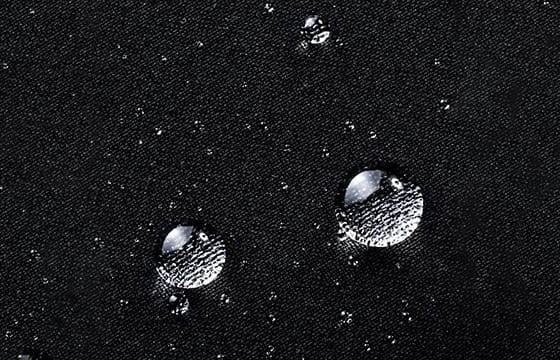
Waterproof/Water-repellent performance: Down is vulnerable to moisture, so these treatments greatly affect usability. Wind resistance also directly impacts perceived warmth.
Differences in Warmth by Construction Method
Construction affects both insulation and design. Stitched (quilted) construction is lightweight and suitable for urban wear.
Box (baffle) construction maximizes loft and offers superior warmth, making it ideal for mountaineering and extreme cold.
Stitched (quilted) construction: The outer and inner fabrics are sewn directly together, resulting in a lightweight, stylish design, but cold air can enter through seams—best for city wear.
Box (baffle) construction: Internal partitions create three-dimensional chambers that prevent down shifting and cold air intrusion, delivering high insulation for harsh, cold environments.
Maintain and Store Properly to Preserve Warmth
Down is sensitive to moisture and compression, so daily care is essential to maintain its loft.
Proper cleaning according to care labels and breathable storage help prevent fill power degradation.
After wearing, air-dry in the shade to remove moisture; during the off-season, hang with a nonwoven cover. Avoid compression bags.
For home washing, use a neutral detergent and low-speed spin; add tennis balls to the dryer to help restore loft.
Check not only fill power but also care history, and inspect condition before the season to maintain comfort.
Brand-Specific Fill Power Trends and Characteristics
Each brand adopts different fill power ranges and design philosophies.
Below are representative brands with their typical FP ranges and characteristics.
* Values are examples and may vary by model.
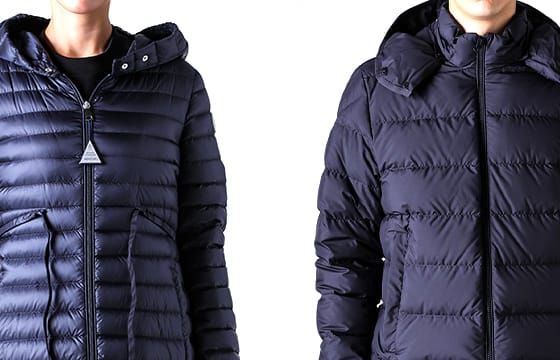
MONCLER (Moncler): 800–1000 FP
Moncler uses goose down rated at 800 FP or higher, with some models reaching up to 1000 FP.
Lightweight yet highly insulating, it achieves excellent cold protection and wind resistance through high-density fabrics.
Refined designs make it suitable for everything from city wear to formal settings.
Many models feature goose down with 800 FP or above, while top-tier lines are engineered to reach up to 1000 FP.
By combining lightness and warmth with high-density fabrics that prevent down leakage,
Moncler achieves both wind resistance and an elegant silhouette.
← Horizontal scroll available →
FP Range
Intended Use
Features
800–1000
City wear to extreme cold
High-quality goose down. Lightweight with excellent insulation. Balances design and functionality
HERNO: 700–800 FP
Herno generally adopts 700–800 FP.
The Laminar series uses high-performance materials such as GORE-TEX,
offering windproof, waterproof, and breathable properties.
A sleek silhouette that minimizes bulk is a key feature.
← Horizontal scroll available →
FP Range
Intended Use
Features
700–800
Urban life / bad weather
Uses high-performance materials such as GORE-TEX. Ensures waterproofing, wind resistance, and breathability with a sleek design
MACKAGE: 800 FP and above
Mackage adopts 800 FP or higher in many models, with some rated for temperatures as low as −35°C.
By using nano down, it balances insulation and breathability while emphasizing design,
proposing luxury performance outerwear.
← Horizontal scroll available →
FP Range
Intended Use
Features
800+
Extreme cold / urban winter wear
Offers models rated to −35°C. Nano down balances breathability and warmth with a refined design
TATRAS: 700–800 FP
Tatras uses Polish white goose down, securing 700–800 FP.
Even with a lightweight build, it delivers high insulation,
characterized by an urban and refined silhouette.
← Horizontal scroll available →
FP Range
Intended Use
Features
700–800
General urban use
Uses Polish goose down, achieving high insulation even in a lightweight build with an urban silhouette
CANADA GOOSE: 625–800 FP
Canada Goose primarily offers three FP ranges—625, 750, and 800.
Its proprietary ARCTIC TECH® fabric ensures abrasion resistance and water repellency,
while the TEI rating displays warmth across five levels, enabling selection based on intended use.
← Horizontal scroll available →
FP Range
Intended Use
Features
625
Core models
Designed for urban cold-weather protection with durability and balanced insulation
750
Lightweight series
Lightweight designs suitable for long wear, optimized for specific uses
800
High-performance models
For extreme cold and mountaineering. Warmth levels are indicated via the TEI rating for purpose-based selection
Summary: Choosing the Right Down Jacket by Use Case & Fill Power
Selecting the appropriate FP for your intended use is the key to comfort. In addition to FP, it is also important to carefully check the fill weight, materials, and construction.
For city wear, 600–700 FP is a good guideline. Prioritize a balance between ease of movement and design.
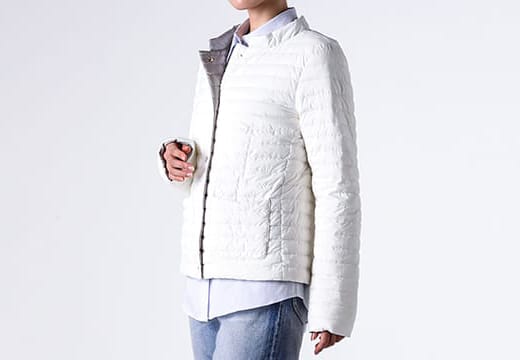
Inner down jackets are typically around 400–600 FP, making them easy to layer and suitable for transitional seasons.
For outdoor use, 700–800 FP models with windproof and water-repellent features offer peace of mind.
For extreme cold regions or mountaineering, 800 FP or higher is essential. Be sure to check insulation, sealing, and water resistance.
By understanding the required fill power range and functionality for each purpose, it becomes easier to choose a comfortable piece suited to the season and occasion. Use the guidelines below to find a model that matches your lifestyle.
For town use, lightweight and versatile models are recommended
Recommended fill power: 600–700 FP
For everyday wear or commuting in the city, ease of movement and styling versatility are essential. Matte-finish nylon materials and minimalist, hoodless designs work well for both casual and formal settings.
Inner down jackets for layering from transitional seasons to midwinter
Recommended fill power: 400–600 FP
Thin and lightweight inner down jackets are highly useful during transitional seasons and for layering. They work well on their own and provide extra warmth when worn under a coat in midwinter. Slim styles that fit easily under suits are also popular.
For outdoor activities, high-performance and high-insulation models provide confidence
Recommended fill power: 700–800 FP
For leisure activities and travel to cold regions, outdoor-oriented models that combine wind resistance, water repellency, and insulation are reassuring. Pay attention to functional details such as ample pockets and detachable hoods that support active use.
In snowy regions or mountaineering, balancing high FP with overall performance is crucial
Recommended fill power: 800 FP or higher
In extreme cold environments, not only high FP but also sufficient down fill, strong sealing, and water resistance are required. Look for voluminous silhouettes with well-packed down, as well as designs that block cold air, such as drawcords at the cuffs and hood.
Store Information|MARUTAMIBOND by FASCINATE
Founded in 1952, MARUTAMIBOND is a men’s and women’s select shop offering a carefully curated lineup of international and Japanese brands.